Strength reduction by finite elements
The soils' strength is divided by a growing factor until the ground can't hold itself up. No slip surface is assumed: the failure appears where it wants to, circle or not.
Draw the ground, give its soils and its water, and get the factor of safety two independent ways: by finite elements that find the failure on their own, and by the slip circles engineers have trusted for a century. When they agree, you can too.
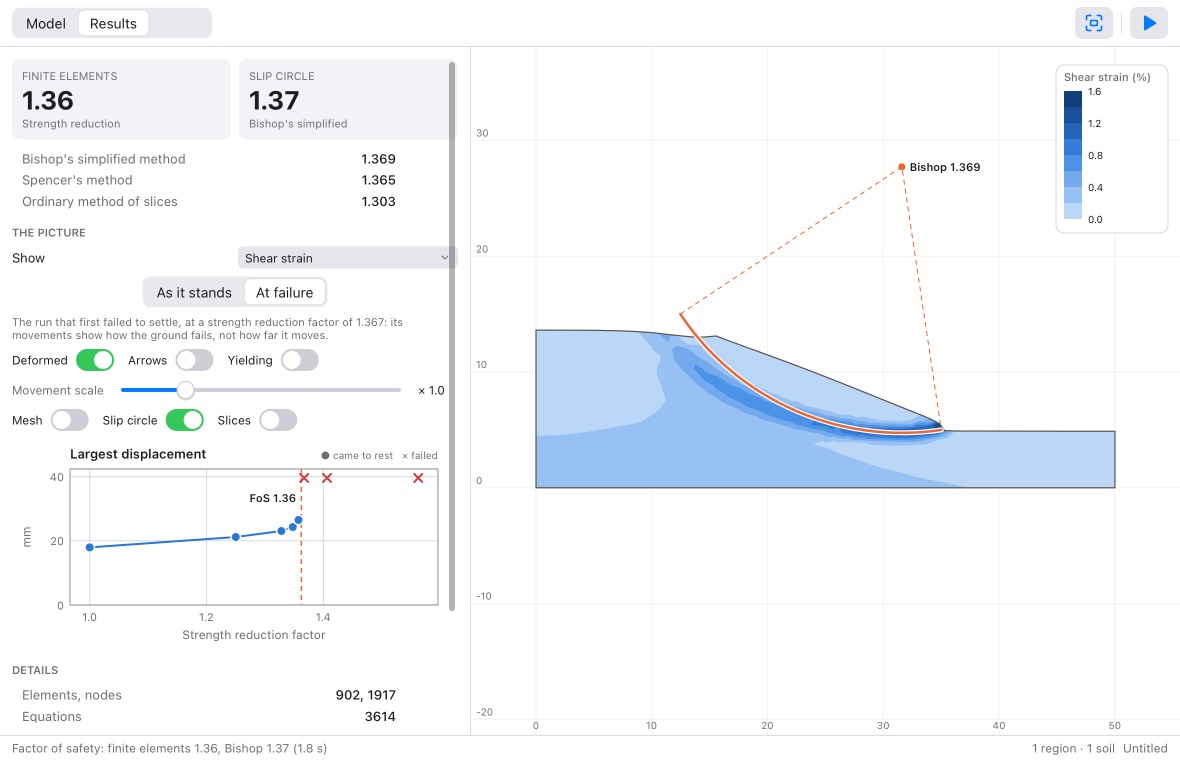
From a sketch of the ground to a report, in two views: Model and Results.
The soils' strength is divided by a growing factor until the ground can't hold itself up. No slip surface is assumed: the failure appears where it wants to, circle or not.
Thousands of circles searched with Bishop's simplified method; Spencer's method and the ordinary method of slices on the critical one, to compare.
Regions drawn with the mouse or typed, each of one soil. Corners snap to corners, middles of sides and sides, with the exact coordinates shown as you go.
A water table with standing water on the ground, steady seepage that finds its own free surface, or ru. The pore pressures go into both analyses.
A reservoir drawn down, a canal emptied: the water's support goes, the pore pressures stay. By the B̄ method, with soils that drain and soils that don't.
Surcharges and line loads on the ground, and pseudo-static seismic coefficients each way.
Reinforcement limited by its tensile capacity and by what the ground can pass to it. Each bar's tension is reported, in both analyses.
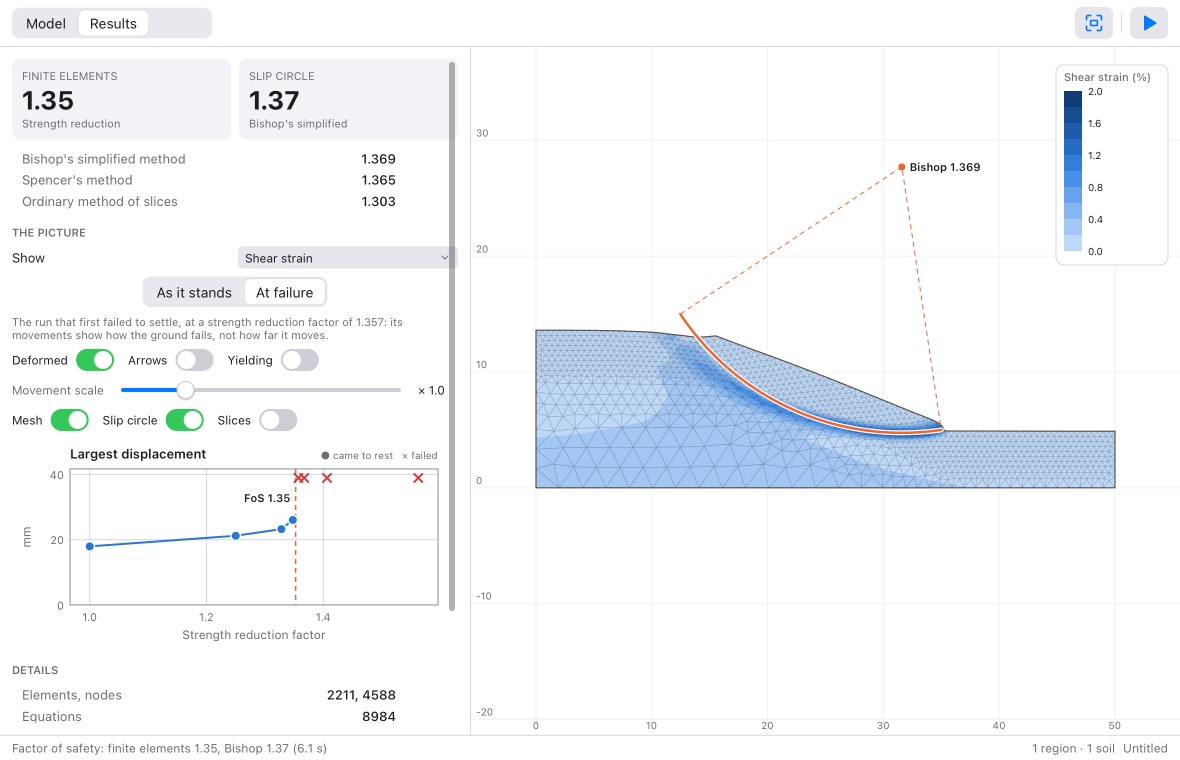
Six-noded triangles made for you. Coarser at depth, or a size of its own for any region, when you want a sharper answer for less work.
The model, the pictures, both factors of safety and how they were found, as a PDF or an HTML page. A guide and two tutorials are built in.
Click the corners of each region. An orange mark shows what the next corner snaps to: a corner, the middle of a side, or a place on a side. Regions that touch share their corners exactly.
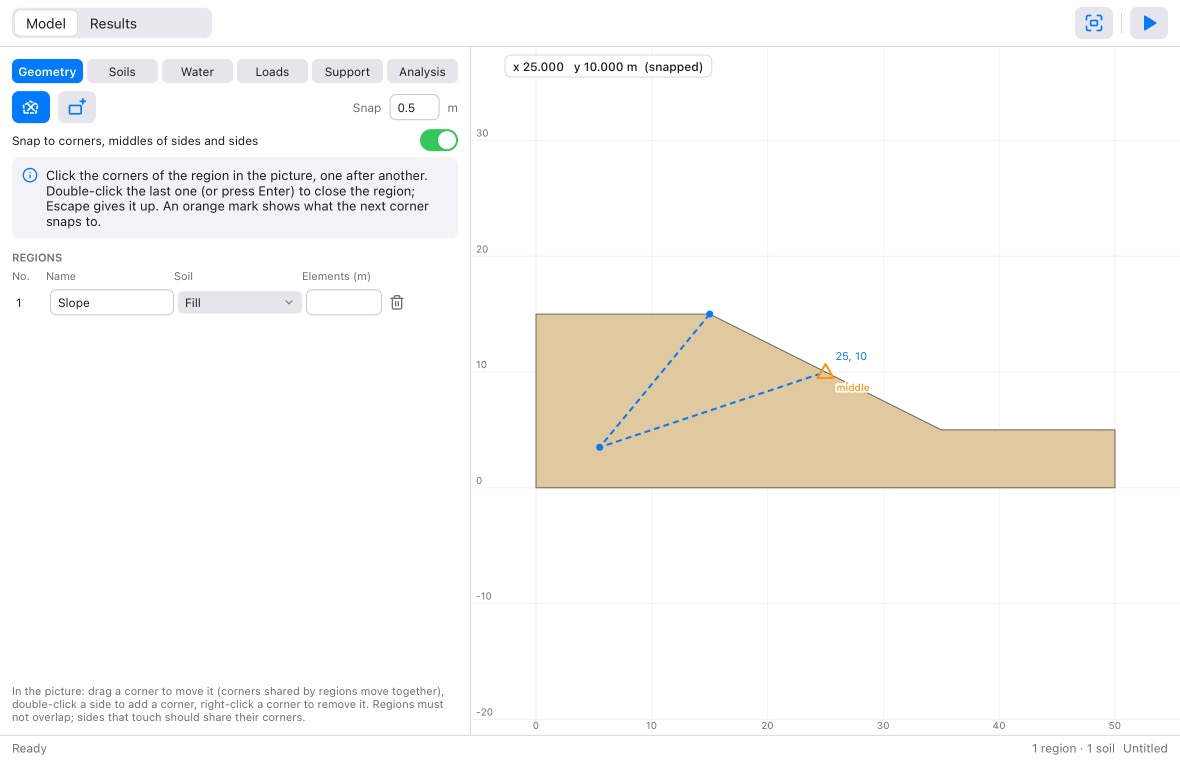
Both factors of safety in a second or two. The dark band is where the finite elements say the ground shears; the orange arc is the critical circle. Here they lie on top of each other.
Give the water levels against a dam and the seepage is solved on the same mesh: pore pressures, total head, the top of the water, and the flow through the dam.
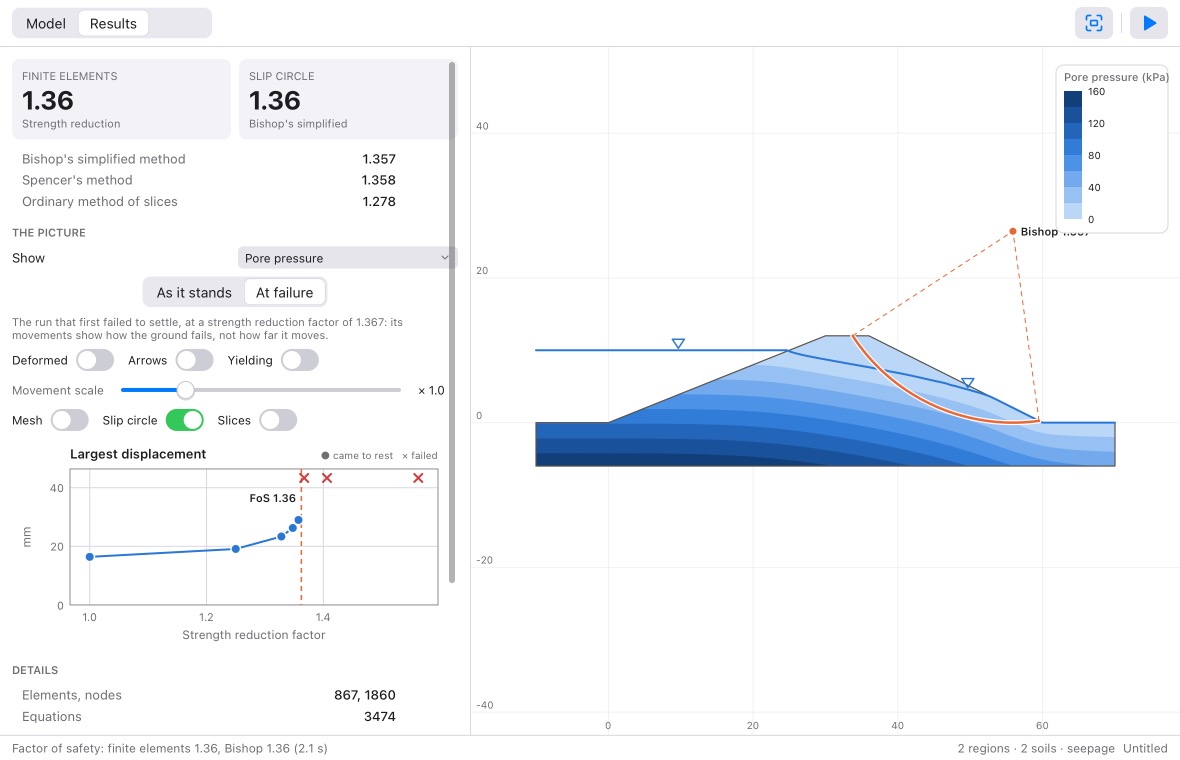
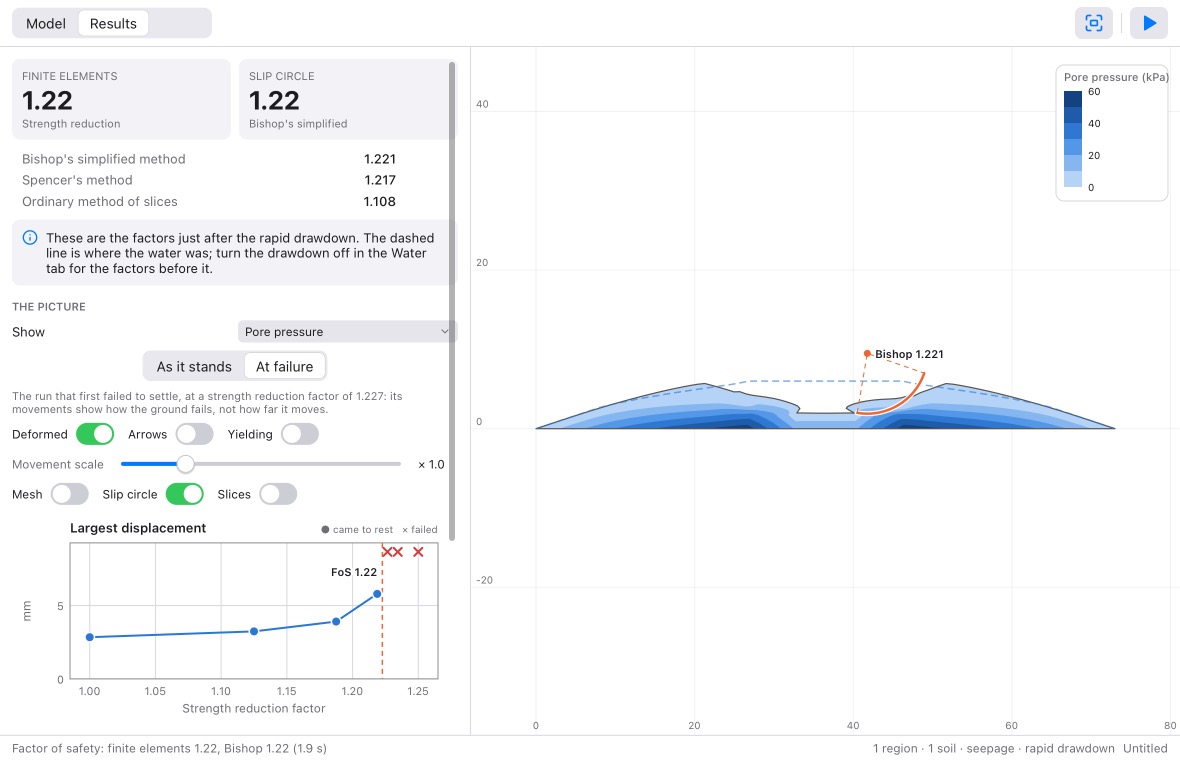
Full, this canal's banks have a factor of 1.8. Emptied at once, 1.2, and the slope that fails is now an inner one. The dashed line is where the water was.
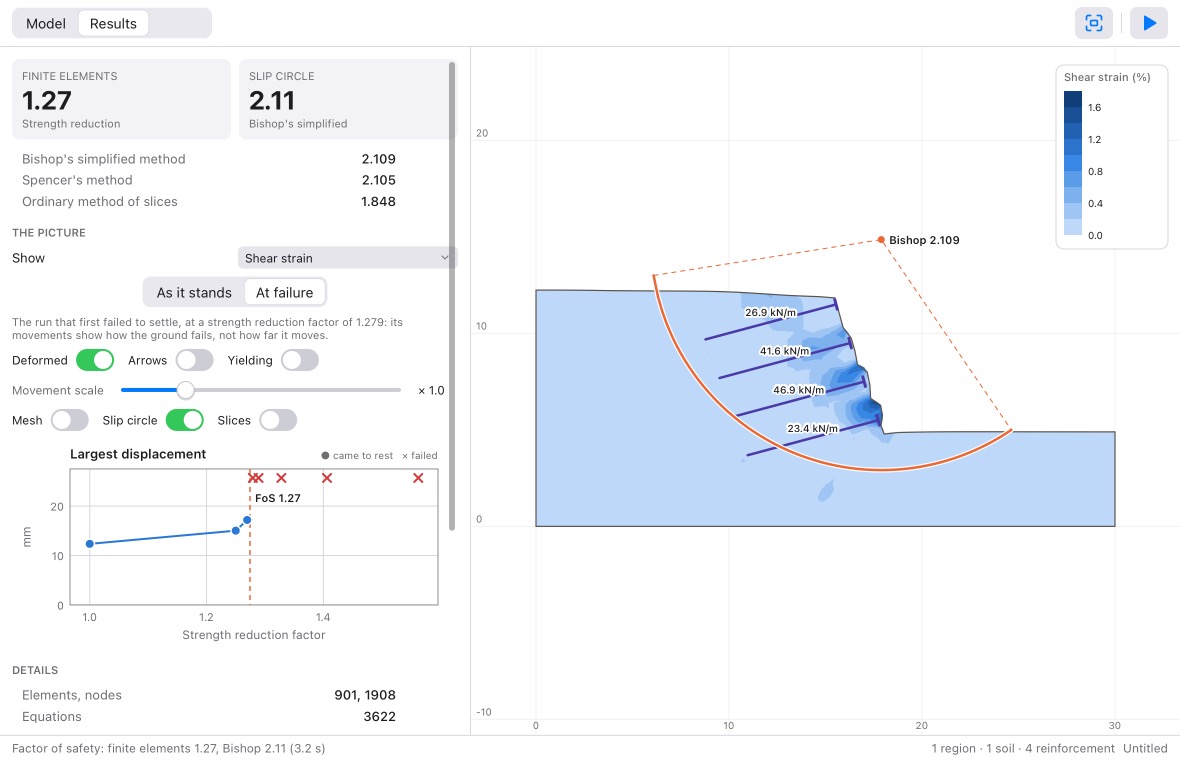
Soil nails, anchors with a free length, layers of geogrid. The results show the tension each one carries. Here the circle says the cut as a whole is safe, while the finite elements show its face giving way between the nail heads: no facing is modelled.
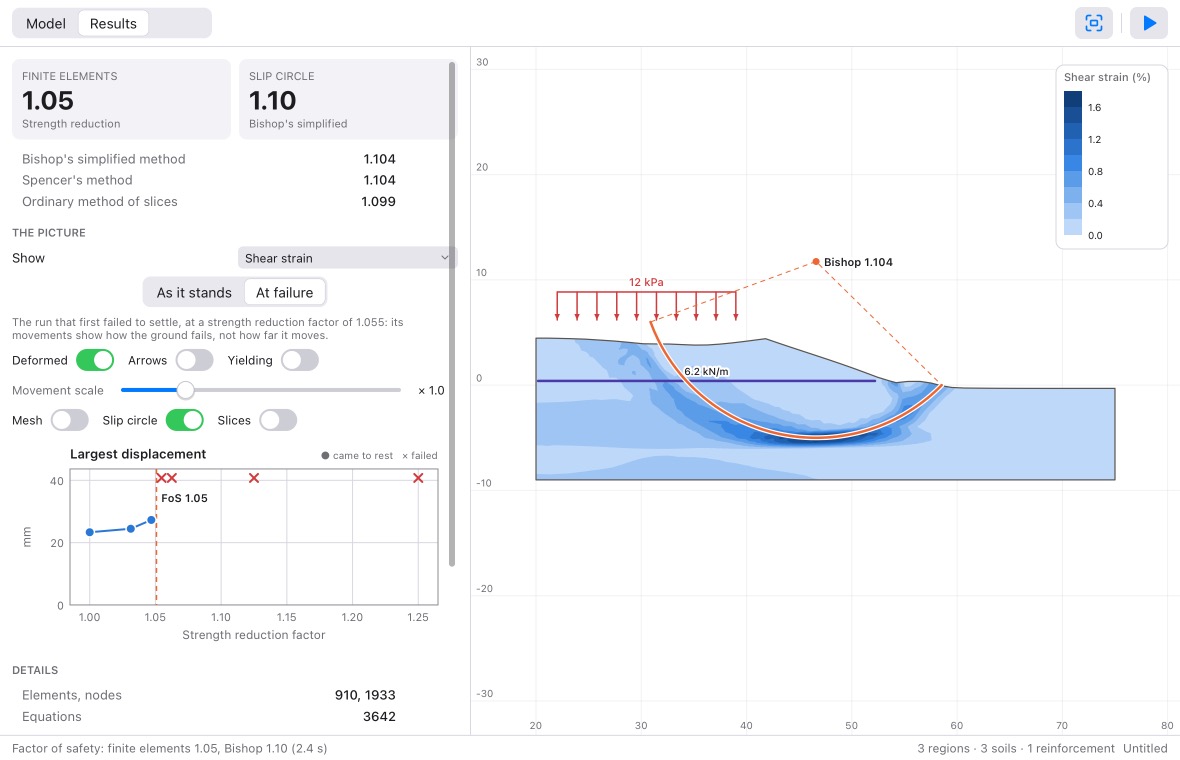
On soft clay over a stiff layer the ground slides along the layer. No circle can follow that; the finite elements do, and give the lower, truer factor.
Worked examples from books and papers, entered as their authors give them. They are in the app's Published menu, and its tests run them every time it's built.
| Example | Published | Slope |
|---|---|---|
| One given circle by three methods: ordinary, Bishop, SpencerFredlund and Krahn (1977), Canadian Geotechnical Journal | 1.928 / 2.080 / 2.073 | 1.927 / 2.081 / 2.075 |
| The same circle with a piezometric lineFredlund and Krahn (1977) | 1.693 / 1.834 / 1.830 | 1.693 / 1.836 / 1.831 |
| A given arc with a water table: Bishop, ordinaryCheng and Lau (2008), Slope Stability Analysis and Stabilization, Fig. 2.4 | 1.023 / 0.991 | 1.018 / 0.988 |
| Strength reduction by finite elements; Bishop and Morgenstern's chartSmith, Griffiths and Margetts, Programming the Finite Element Method, Program 6.4 | 1.6 / 1.593 | 1.58 / 1.592 |
| Rapid drawdown to mid-height, by finite elementsGriffiths, slope64 example 6 | 1.03 | 1.04 |
| Undrained slope, critical circleDuncan and Wright (2005), Soil Strength and Slope Stability, Fig. 14.3 | 1.124 | 1.123 |
| Sand embankment on clay: Bishop, SpencerDuncan and Wright (2005), Fig. 7.12 | 1.22 / 1.19 | 1.19 / 1.17 |
| James Bay dyke: a circle; a surface that isn't oneDuncan and Wright (2005), Fig. 7.16. Slope's second number is its finite elements, which find that surface unaided | 1.45 / 1.17 | 1.41 / 1.21 |
| The earthquake that brings a slope to a factor of 1: Spencer, finite elementsLoukidis, Bandini and Salgado (2003), Géotechnique | 1.000 | 1.001 / 1.00 |
| Referees' answer for a homogeneous slopeACADS problem 1(a), Giam and Donald (1989) | 1.00 | 0.985 / 0.98 |
Given circles agree to the third decimal. Where Slope searches, it sometimes finds a slightly lower circle than the book's. The app's guide lists every case, its source and what the differences mean.
The Examples menu opens ready-made slopes. Open one, press Run, and change it to see what matters.
An engineer should know where a tool stops. Slope says so in its guide, and here.
Slope is an aid to an engineer's judgment. Check its results against your own before building on them.
Slope runs on macOS, with Windows to follow.